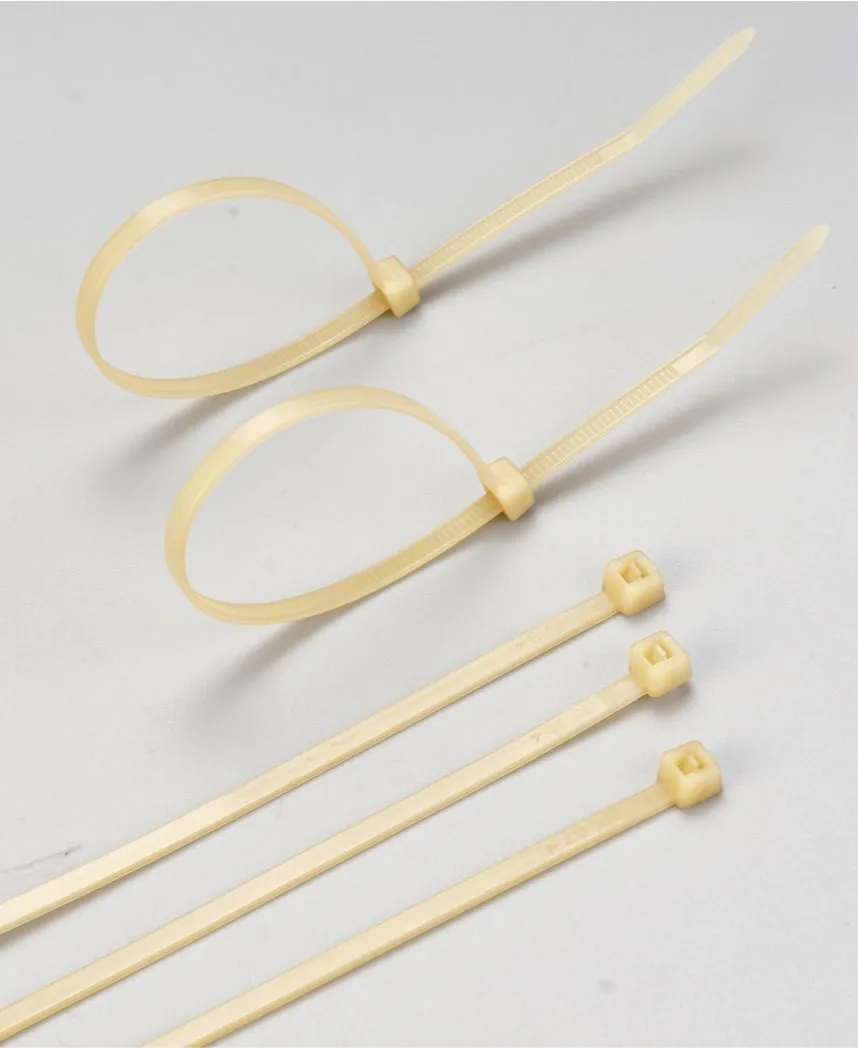
Two numbers define a cable tie: its length and its width. Length decides the largest bundle the tie can close. Width decides how much load it can hold before the locking head releases. These are independent dimensions, and treating one as a proxy for the other is the single most common sizing mistake — it produces either a tie that will not reach around the bundle, or one that snaps the first time the harness flexes. This guide gives the length-to-bundle conversion, the standard tensile classes, the safety factors that turn a breaking strength into a working load, and a selection table built from our own 52-model nylon range so you can pick a part number directly.
A Cable Tie Is Specified by Length x Width
Every catalogue entry follows the same convention: length first, then width. A "300 x 4.8 mm" tie is 300 mm long from the tip of the tail to the end of the head, and 4.8 mm across the strap. Both figures are moulded to tolerance, and both matter — but they solve different problems.
- Length answers "will it go around?"
- Width answers "will it hold?"
- Thickness and material refine the answer to "will it still hold in this environment?"
The mistake is selecting on length alone, or assuming a longer tie is automatically a stronger one. It is not. A 370 mm x 2.5 mm tie holds 18 lbs; a 150 mm x 7.6 mm tie holds 120 lbs. The short tie is nearly seven times stronger than the long one.
Length: How Large a Bundle Will It Close?
Roughly, the strap has to travel around the bundle, and the head and a minimum tail consume length that never contributes to the bundle circumference. So the arithmetic is:
Max bundle diameter ≈ (strap length − head and tail allowance) ÷ π
The allowance is around 25–35 mm for a standard head and the minimum tail that will seat and lock. In practice you do not need to calculate it: every reputable manufacturer declares a maximum bundle diameter per part number, tested to the geometry of that specific head. Use the declared figure. Here is how length maps to bundle diameter across our nylon range:
| Length (mm) | Length (in) | Max. bundle dia. (mm) | Typical use |
|---|---|---|---|
| 100 | 4" | 22 | Wire pairs, cable markers, tags |
| 150 | 6" | 35 | Control wiring, small harness branches |
| 200 | 8" | 50 | Panel wiring, the general-purpose size |
| 250 | 10" | 63–65 | Larger harnesses, appliance leads |
| 300 | 12" | 82 | Conduit, tray drops, hose |
| 370 | 14 1/2" | 102 | Bundle build-up, flexible conduit |
| 450 | 17 3/4" | 118–130 | Large tray bundles, duct |
| 550 | 22" | 160 | Industrial bundles, plant rooms |
| 700 | 27 1/2" | 200 | Structural runs, pipework |
| 920 | 36" | 265 | Utility, infrastructure, large ducts |
Two points worth noting. First, the same nominal length gives a slightly different bundle diameter depending on width, because a wider strap requires a larger head — a 250 mm x 4.8 mm tie closes 65 mm, while a 250 mm x 7.6 mm tie closes 63 mm. Second, the declared figure is a maximum: at full extension the strap is at its limit, with no tail left for retensioning or for the bundle to swell. Leave 15–20% of the bundle diameter as margin anywhere the bundle will move, vibrate, or grow.
Width: What Sets the Tensile Class
Tensile strength is quoted as minimum loop tensile strength — the force at which the assembled tie, with its locking mechanism engaged, fails. It is defined identically in UL 62275 and IEC 62275, which is why the classes below are comparable across suppliers. Width is the dominant variable, and the industry groups ties into six practical classes:
| Width (mm) | Width (in) | Class | Min. loop tensile | Typical use |
|---|---|---|---|---|
| 2.5 | 0.10" | Miniature | 18 lbs / 8 kg | Fine wire, electronics, tags |
| 3.5–3.6 | 0.14" | Intermediate | 40 lbs / 18 kg | Small harnesses, light bundling |
| 4.6–4.8 | 0.19" | Standard | 50 lbs / 22 kg | The general-purpose class |
| 6.8 | 0.27" | Medium heavy | 90 lbs / 40 kg | Heavier harnesses, panels |
| 7.6 | 0.30" | Heavy duty | 120 lbs / 55 kg | Tray, conduit, outdoor bundling |
| 9.0 | 0.35" | Extra heavy duty | 175 lbs / 80 kg | Structural, vibration, large runs |
| 10.0 | 0.39" | Heavy industrial | 200 lbs / 91 kg | Long-heavy spans, plant rooms |
| 12.7 | 0.50" | Super heavy duty | 250 lbs / 114 kg | Pallet, rack, sign, structure |
The class names are conventions, not standards — the exact width breaks vary by manufacturer and by head design. What matters is the declared loop tensile for the specific part number, not the class label. Note also that thickness plays a supporting role: two ties of the same width moulded at different strap thicknesses will not carry the same rating.
Selection Table: Our 52-Model Nylon Range by Width
Rather than quote generic industry figures, here is the shape of our own self-locking nylon cable tie range, grouped by strap width. Each group shows the length span available, the tensile class, and the part-number prefixes so you can jump straight to a model.
| Width | Models | Length range | Max bundle | Tensile | Example part numbers |
|---|---|---|---|---|---|
| 2.5 mm | 7 | 60–200 mm | 11–50 mm | 18 lbs / 8 kg | HS-60A, HS-100A, HS-200A |
| 3.5 mm | 8 | 120–370 mm | 30–102 mm | 40 lbs / 18 kg | HS-120B, HS-250B, HS-370B |
| 4.6–4.8 mm | 14 | 120–530 mm | 24–147 mm | 50 lbs / 22 kg | HS-150C, HS-300C, HS-500C |
| 6.8 mm | 2 | 300–370 mm | 82–102 mm | 90 lbs / 40 kg | HS-300DS, HS-370DS |
| 7.6 mm | 10 | 150–550 mm | 33–160 mm | 120 lbs / 55 kg | HS-150D, HS-300D, HS-550D |
| 9.0 mm | 10 | 430–1168 mm | 112–360 mm | 175 lbs / 80 kg | HS-430DL, HS-700DL, HS-1168DL |
| 10.0 mm | 2 | 500–800 mm | 150–230 mm | 200 lbs / 91 kg | HS-500EL, HS-800EL |
| 12.7 mm | 1 | 550 mm | 160 mm | 250 lbs / 114 kg | HS-550FL |
The full 52-model table lists every length, width, maximum bundle diameter and tensile rating. The same sizing logic applies to every other tie family we mould — heat-stabilized, flame-retardant V-0 and cold-weather grades share the width classes, so a 4.8 mm tie is the same size whether it is standard nylon or rated for 130°C.
Tensile Strength Is a Breaking Load, Not a Working Load
The number on the datasheet is the load at which the tie fails, measured once, at room temperature, on a new tie. It is not the load you may hang on it permanently. Two derating steps sit between the two.
Safety factor. Apply a margin so that normal variation — a sharp bundle edge, a nick from the tensioning tool, a bundle that shifts — cannot reach the breaking point:
- 3:1 for static loads (some specifications allow 2:1 for indoor, non-critical, non-vibrating bundling)
- 5:1 for dynamic, vibrating or safety-relevant applications
A worked example. A bundle under a static 10 kg load needs a tie rated for at least 30 kg. On our range that is the HS-300D at 120 lbs / 55 kg, not the 50 lbs / 22 kg standard class — 22 kg clears the raw load but fails the safety factor.
Environmental derating. Declared tensile is established at standard laboratory temperature, typically 23°C. At the top of a material's continuous temperature range the same tie is weaker; the further you go past the rated band, the faster the loss. The same applies outdoors, where UV exposure breaks down unmodified nylon over a single season, and in chemical contact, where the polymer can either swell or embrittle. If your application sits near any of these limits, ask for the derated figure rather than assuming the datasheet number still applies — and see cable tie material specifications for the full temperature bands by polymer.
Step-by-Step: Choosing in Six Moves
- Measure the bundle. Wrap a string around the bundle, measure the circumference, divide by 3.14 — or use calipers if the bundle is loose. Add 15–20% margin for swell, movement and retensioning.
- Define the environment. Indoor or outdoor? Maximum temperature? Chemicals, salt, UV, or vibration? This decides the material before it decides the size.
- Estimate the load. What must the tie actually hold, and is the load static or dynamic? Multiply by the appropriate safety factor.
- Pick the width from the load. Match the derated requirement to the tensile class in the table above; step up a class if you are between two.
- Pick the length from the bundle. Choose the shortest standard length whose maximum bundle diameter exceeds your measured bundle plus margin. Going one size longer costs less than a tie that will not close; going several sizes longer wastes tail and bulk.
- Pick the type and material. Self-locking for permanent bundling, releasable where the bundle will be reopened, mountable-head where the bundle is fixed to a panel, metal-detectable in food and pharma lines.
Seven Sizing Mistakes That Cost Real Money
- Choosing on length alone. A tie can wrap the bundle perfectly and still be the wrong width, material, or tensile class.
- Treating tensile strength as a working load. A 50 lbs tie does not safely hold 50 lbs. Apply the safety factor first.
- Assuming all black ties are UV rated. UV resistance comes from an additive package — usually carbon black — not from the colour. Any tie painted or pigmented black without the stabiliser will degrade outdoors just as fast as a natural one.
- Under-specifying width on soft or sensitive runs. A narrow strap concentrates load and can cut into cable jackets, deform soft tubing or crush fibre. Use a wider low-profile tie, or add a protective sleeve.
- Cutting tails flush and sharp. A flush cutter removes the tail without leaving a knife edge; side cutters leave a spike that becomes a hand injury and an abrasion point for adjacent cables.
- Copying a rating from a look-alike product. Tensile and approval records belong to a verified part number, not to a shape.
- Buying on unit price before fixing the specification. Unit cost is meaningless until size, material, environment and approval path are settled — a cheap tie that fails in service is the most expensive component in the assembly.
Fixing the Right Tie, in the Right Size
We have moulded ties at our Yueqing plant since 1997, and every model in our cable tie range carries a declared loop tensile to UL 62275, a declared maximum bundle diameter and a declared temperature band — the three numbers you need to size a tie properly. Alongside the 52-model nylon range we supply stainless steel ties for heat and load beyond nylon, PA46 ties to +195°C, and heat-stabilized, flame-retardant and cold-weather grades in the same size system. The certifications page lists the UL, RoHS and REACH records behind the factory.
Send us the bundle diameter, the load and the environment on your drawing, and our engineers will return the correct part number and a sample for qualification. Request a quote and we will reply within 24 hours with FOB or CIF pricing.