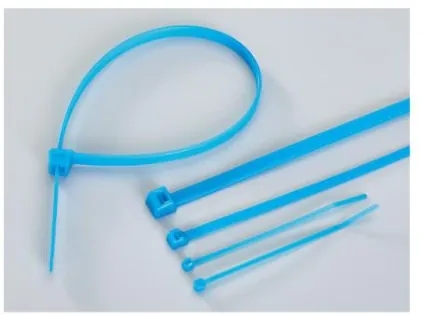
Most cable ties fail in extreme service for one of two reasons: the polymer embrittles under heat and radiation, or it dissolves in contact with process chemicals. Tefzel (ETFE) ties exist to solve both problems at once. They are the default choice inside nuclear power plants, refineries and fluorochemical plants — and they cost several times what a nylon tie costs. This guide explains what the material actually delivers, where it is genuinely required, where it is overkill, and the checks that separate a real Tefzel tie from a tie that is merely blue.
What "Tefzel" Actually Is
Tefzel is DuPont's brand name for ETFE — ethylene tetrafluoroethylene, a fluoropolymer it introduced in 1972. It belongs to the same family as PTFE and PFA: a fluorine-based plastic with an inert backbone that industrial chemicals struggle to attack. Compared with PTFE, ETFE is tougher and far more abrasion resistant, which is why it — rather than PTFE — became the fluoropolymer of choice for cable ties.
The properties that matter in cable management:
- Flammability: UL 94 V-0 rated and halogen-free.
- Moisture absorption: effectively zero. Nylon absorbs 2–3% of its weight in water, which shifts dimensions and strength with humidity; ETFE does not.
- Continuous temperature: the grade we mould runs -60°C to +170°C. Always confirm the declared range for the specific SKU you are buying — plastic-barb and metal-barb designs are sometimes rated differently.
- UV: inherently resistant, so no carbon-black additive is needed for outdoor service.
- Radiation: ETFE is the reason Tefzel ties are specified in nuclear facilities. Published figures commonly cite resistance up to 100 megarads of gamma radiation, with some grades claiming more. If radiation is the driving requirement, ask for the test basis rather than the headline number.
- Chemical resistance: excellent against concentrated acids — including hydrofluoric and sulphuric — as well as strong bases, organic solvents and oxidising agents.
- Outgassing: low, which matters in cleanrooms, vacuum and aerospace assemblies.
How Tefzel Compares with the Alternatives
| Property | Standard Nylon 66 | Heat-stabilized Nylon 66 | Tefzel (ETFE) |
|---|---|---|---|
| Continuous temperature | -40°C to +85°C | -40°C to +130°C | -60°C to +170°C |
| Flame rating | UL 94 V-2 | UL 94 V-2 | UL 94 V-0, halogen-free |
| Concentrated acids | Poor | Poor | Excellent (incl. HF, H₂SO₄) |
| Gamma radiation | Fails quickly | Fails quickly | Rated to 100 Mrad class |
| UV / outdoor | Needs black UV grade | Needs black UV grade | Inherently resistant |
| Moisture absorption | 2–3% | 2–3% | ~0% |
| Identifying colour | Natural / black | Light green / black | Aqua blue |
For general panel wiring, outdoor UV exposure, or automotive under-hood heat, one of the nylon grades — or stainless steel ties for extreme heat and load — will do the job at a fraction of the cost. Tefzel earns its premium only when radiation, aggressive chemistry, or the combination of cryogenic and high-temperature extremes is genuinely on the specification.
Where Tefzel Ties Are the Right Answer
- Nuclear power and fuel handling: instrument and control cabling inside radiological areas, where gamma exposure destroys nylon within months.
- Chemical and petrochemical plants: pump skids, analyser houses and line tracing exposed to acid splash, solvent vapour and wash-down.
- Semiconductor and glass etching: hydrofluoric acid environments, where the tie must survive what HF does to glass.
- Aerospace and vacuum systems: low outgassing and wide temperature range in the same component.
- Laboratories and medical facilities: radiation equipment, sterilisation areas and clean benches.
- Assets that see both temperature extremes: cryogenic feed lines next to hot process equipment — one tie covers the whole run.
The Range: Eight Sizes, 18 to 100 lbs
Our Tefzel cable ties run from a 100 mm / 2.5 mm tie at 18 lbs (80 N) minimum loop tensile up to a 370 mm / 7.6 mm tie at 100 lbs (450 N). Bundle diameters span 22 mm to 102 mm, which covers instrument tubing through to main cable trays.
| Item No. | Length | Width | Max. bundle dia. | Min. tensile |
|---|---|---|---|---|
| HS-100A-TF | 4" / 100 mm | 0.10" / 2.5 mm | 22 mm | 18 lbs / 80 N |
| HS-150B-TF | 6" / 150 mm | 0.14" / 3.6 mm | 35 mm | 40 lbs / 180 N |
| HS-200C-TF | 8" / 200 mm | 0.19" / 4.8 mm | 50 mm | 50 lbs / 220 N |
| HS-300D-TF | 12" / 300 mm | 0.30" / 7.6 mm | 76 mm | 100 lbs / 450 N |
| HS-370D-TF | 14.6" / 370 mm | 0.30" / 7.6 mm | 102 mm | 100 lbs / 450 N |
The full eight-model table — including the B, C and D cross-sections — is on the Tefzel cable ties page. Custom lengths, non-standard colours and bulk packaging are available on request.
Buying Checklist: Seven Things to Verify
Because "blue fluoropolymer tie" is easy to claim and hard to verify visually, put the burden of proof in the documents:
- Material, in writing. Ask for the resin family (ETFE) — not "Teflon-type" or "fluoro-coated". A material certificate naming the polymer is the baseline.
- Declared continuous temperature range. Confirm the number attached to the exact part number, and whether it refers to continuous or short-term exposure.
- Radiation basis, if relevant. For nuclear work ask what dose the rating is based on, and under what test or reference.
- Flame rating and halogen content. UL 94 V-0 plus halogen-free matters in enclosed cabinets, tunnels and cleanrooms.
- Colour is not proof. Aqua blue is the industry convention, but any moulder can pigment nylon blue. Only the documents and the UL record settle it.
- Locking mechanism. Metal-barb and plastic-barb designs differ in temperature capability and in how they behave on soft insulation. Match the design to the application.
- Price sanity. ETFE resin costs a multiple of nylon. A quote priced close to nylon is a signal to ask harder questions about the material.
Ordering Tefzel Ties with Confidence
We mould the HS-TF series from UL-approved Tefzel (ETFE), rated UL 94 V-0 and -60°C to +170°C, in the eight sizes above. As a cable tie manufacturer since 1997, we supply the material documentation with the quotation, so your engineering team can qualify the part before the first container ships. Our wider cable tie range covers the nylon, heat-stabilized and flame-retardant grades you will use elsewhere in the same plant, and our certifications page lists the UL and ISO records behind the factory.
Tell us the environment — radiation dose, chemical exposure, temperature band and bundle diameter — and our engineers will confirm the right polymer and part number, then send samples for your qualification. Request a quote with your specification and we will respond within 24 hours with FOB or CIF pricing.