Off-the-shelf cable ties solve most bundling problems. The ones they do not solve are the commercially interesting ones: your logo on the bag, a colour that matches a customer's panel, a length that fits an existing assembly fixture, a retail-ready pack that can sit on a shelf instead of in a bin. Custom manufacturing is what separates a commodity supplier from a brand — and it is more procedural than most first-time buyers expect. This guide covers the four things you can customise on a cable tie order, how each process actually works, what drives the cost, and the questions to settle before you place a first order.
Four Dimensions of Customisation
A cable tie order has four independent specification layers. Any of them can be standard or bespoke, and the cost of going bespoke is different for each.
| Layer | What can be customised | What drives the cost |
|---|---|---|
| Size | Length, width, tensile class, head design | New mould if outside the existing tooling range |
| Material | PA66, heat-stabilized, PA46, flame-retardant V-0, PP, stainless steel 304/316 | Resin price and certification scope |
| Colour | Any Pantone or RAL reference, or matching a supplied sample | Masterbatch MOQ and colour-matching run |
| Packaging & labels | Private-label bag labels with your logo, bulk, retail card, blister, FBA-ready, branded carton, multilingual labels | Label printing and manual packing time |
Most first orders combine two of these — typically colour plus private-label packaging — while keeping the size from the existing catalogue. That is the cheapest way to get a branded product, because no new mould is required: the ties themselves stay standard, and your brand lives on the pack.
Colour: Masterbatch, and the UV Trap
Coloured ties are not painted. Colour is introduced as masterbatch — a concentrated pigment pellet — blended with the nylon before the tie is moulded, so the colour runs through the full cross-section and cannot chip off. That is why a coloured tie keeps its colour even where it has been cut or abraded.
Supply a Pantone or RAL reference, and we will run a colour chip for approval before production, because the same pigment reads differently on nylon than it does on paper or on a painted panel. Approval on a physical sample avoids a whole container of the wrong shade.
The UV trap is the part most buyers miss. Outdoor resistance in nylon comes from an additive package — historically carbon black, which is why the classic UV-stable tie is black. A black tie is therefore usually UV-stabilised, but a red, yellow or blue tie is not automatically. Pigment and UV stabiliser are separate additions to the compound, and a supplier who simply drops colour into the mix can produce a brightly coloured tie that embrittles in sunlight within a season. If the coloured tie is going outdoors, say so explicitly in the RFQ and require the UV specification in writing, with the weathering test basis. The full additive picture is set out in cable tie material specifications.
Colour also does work that has nothing to do with branding: colour-coding is standard practice for identifying circuits, voltage bands, zones and hose lines, so a small run of four or five colours is often an operational requirement rather than a marketing one. And if the requirement is identification rather than branding — labelling a cable rather than a product — a dedicated marker tie or cable marker carries a write-on flag or label pocket, which is more legible than any permanent mark and can be changed in the field.
Packaging: Where OEM Branding Actually Lives
Packaging is the layer buyers most often treat as an afterthought, and it is usually the fastest route to differentiating a product in a retail or e-commerce channel. For most OEM programmes it is also where the customer's brand belongs: the ties stay standard, and the brand lives on the pack.
- Private-label bags. Your logo, part number and details printed on the bag label — the most common form of cable tie OEM branding. The ties themselves remain standard catalogue items, so there is no mould cost and no effect on the tie's certifications; the brand identity is carried entirely by the label and the pack.
- Bulk. 100 or 1,000 pieces per bag, plain cartons. The lowest unit cost, and the right choice for industrial users who decant into bins.
- Retail card or blister. Printed card, hang hole, quantity and barcode visible. Needs printed packaging and a packing line, so it carries a per-unit cost that only makes sense at retail price points.
- E-commerce / FBA-ready. FNSKU labelling, suffocation warnings, correct carton dimensions and weight declarations. Getting these wrong is expensive in inbound rejections, so specify them up front rather than discovering them at the fulfilment centre.
- Branded cartons and multilingual labels. Your SKU, your part numbers, your languages — useful when the same container serves several markets.
If your own brand identity has to appear on the pack, supply the label artwork files at quotation stage; artwork revision is far cheaper before proofs than after.
Tooling, MOQ and Sampling
Two things decide whether a custom order is economical: whether a new mould is needed, and how many separate customised elements are stacked on one order.
- Size within existing tooling — no mould cost. We supply the standard ranges in colour and packaging variants with a low minimum for trial orders.
- Non-standard size or a new head design — requires a mould, so the commercial question becomes the payback across the expected annual volume.
- Custom colour — the masterbatch itself has a minimum, which is why colour gets cheaper per unit as the run grows.
- Private-label packaging — label printing has a setup per design, so it is cheapest to fix the artwork before the first run.
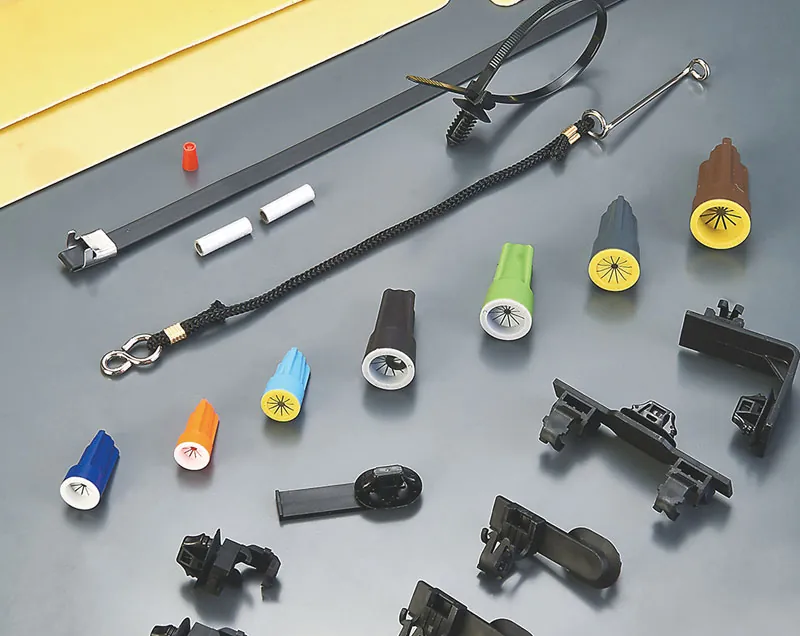
The sequence is the same in every case: specification review, engineering assessment, a physical sample for your approval, then production. Never approve a custom tie from a photograph or a 3D rendering. Colour, tail behaviour and locking feel all have to be checked in the hand — that is what the approval sample is for. If you also need moulded clips, fasteners or special parts alongside the ties, the same tooling process covers them, and consolidating them in one order avoids paying tooling twice.
What to Put in the RFQ
A complete request for quotation removes an entire round of emails. Include:
- Destination market and approvals — UL, CE, RoHS, REACH, or food-contact requirements. Approval scope shapes the material choice.
- Application or dimensions — bundle diameter, load, indoor or outdoor, temperature, chemical or UV exposure.
- Material preference, or the environment so we can recommend one. See the size and tensile selection guide if the load and bundle are already known.
- Colour — a Pantone or RAL code, or a physical sample to match.
- Packaging and labels — bag or carton style, quantity per pack, your logo artwork (vector file), barcode and label layout.
- Expected annual volume, so pricing can be quoted at the right tier and the tooling payback assessed.
- Documents required — material certificate, tensile test report, ageing or salt-spray report, RoHS/REACH declaration.
If the requirements are not yet fixed, send the application rather than a part number. A short description of where the tie will be used is usually enough for our engineers to propose the material and geometry, and it is faster than iterating on a wrong specification. Our custom OEM/ODM service runs on the same process.
Verifying the Supplier Behind the Custom Order
Custom work concentrates risk: a bespoke colour, a private-label bag and a branded carton are all specific to you, so a supplier who cannot deliver leaves you with inventory you cannot sell to anyone else. Three checks are worth doing before the first production order.
- Certification scope, not just certification. Confirm which part numbers sit under which file; the verification method is set out in how to verify a cable tie UL certificate.
- Material compliance. RoHS and REACH declarations should name the substance lists and the version applied — see RoHS and REACH compliance for what a usable declaration contains.
- Process control. Batch-level test reports and a documented quality system are what keep the tenth container identical to the first sample — the same subject the UL 62275 type classification addresses from the standards side.
Custom Ties, From Mould to Container
We are a cable tie manufacturer since 1997, with our own mould workshop, a CNAS-accredited laboratory and a 25-year record of injection moulding at our Yueqing plant. That combination is what makes custom work practical rather than theoretical: we cut the mould, mould the part, verify it in our own lab and label and pack it under one roof, so a bespoke tie does not have to travel between four subcontractors before it ships. The certifications page lists our UL records, our ISO 9001, ISO 14001 and ISO 45001 systems and our IATF 16949 automotive approval.
Send us a drawing, a sample, or simply the application, and we will come back with a material proposal, a sample plan and pricing on your expected volume. Alongside custom ties we supply the full cable tie range and the cable clips and mounts that go with them, so a branded programme can be sourced in one place. Request a quote and our team will reply within 24 hours.