2026-07-15
Why Food Factories Use Metal Detectable Cable Ties on Production Lines
Walk into almost any modern food production facility and you will notice one thing.
Everything has a place.
Every cable is routed carefully.
Every piece of equipment is cleaned regularly.
Every process has a procedure.
Every piece of equipment is cleaned regularly.
Every process has a procedure.
In the food industry, small details matter because a small mistake can become a big problem.
A loose screw, a broken plastic piece, or a damaged component can create a contamination risk that no production manager wants to deal with.
That is why more food processing companies are paying attention to something as simple as cable ties.
The Problem With Standard Cable Ties in Food Production
Standard nylon cable ties are widely used in factories.
They are affordable, easy to install, and work well in many applications.
But food production environments have stricter requirements.
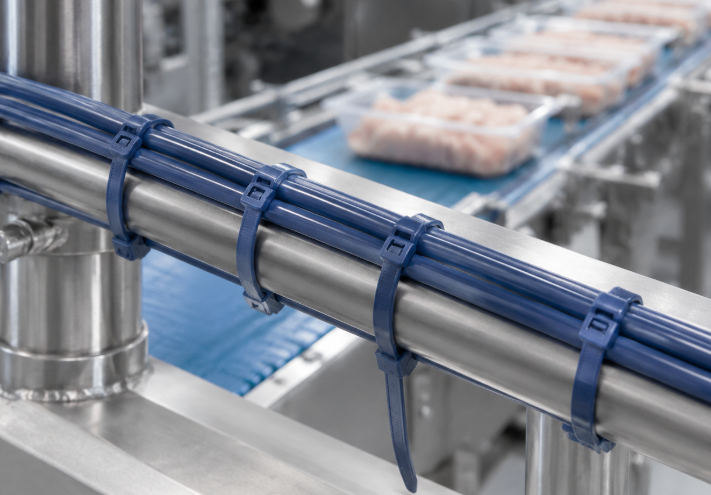
A cable tie may be installed above a conveyor belt, inside processing equipment, near packaging machines, or around electrical wiring close to production areas.
Over time, vibration, cleaning operations, heat, and daily maintenance can put stress on these small components.
If a standard plastic cable tie breaks, finding that small piece can be extremely difficult.
And in food manufacturing, anything that cannot be easily detected creates an unnecessary risk.
A Small Plastic Part Can Become a Big Production Issue
Imagine a typical food processing line.
There are conveyors moving products every minute.
There are motors, sensors, control panels, and hundreds of meters of wiring.
During maintenance, an operator replaces a sensor cable and cuts a cable tie.
Everything seems normal.
But a small piece falls somewhere near the production area.
Maybe it gets cleaned away.
Maybe it stays hidden.
Maybe nobody notices.
This is exactly the type of situation food safety teams try to prevent.
The problem is not the cable tie itself.
The problem is that traditional plastic pieces are difficult to identify once they enter the production environment.
How Metal Detectable Cable Ties Help Food Manufacturers
This is where Metal Detectable Cable Ties become useful.
Unlike standard cable ties, detectable cable ties contain special additives that allow fragments to be identified by metal detection systems commonly used in food processing.
They are designed for environments where contamination control is critical.
The goal is simple:
If something breaks and enters the production area, the detection system has a better chance of finding it before the product reaches the customer.
This additional layer of protection is why they are commonly used in:
-
Meat processing facilities
-
Seafood production
-
Dairy plants
-
Bakery production lines
-
Beverage factories
-
Pharmaceutical manufacturing
Where We See Detectable Cable Ties Used Most
In real production environments, these cable ties are usually found in places where normal maintenance happens frequently.
For example:
Conveyor Systems
Conveyors often require multiple sensors and cables.
During daily operation, vibration is unavoidable.
Using detectable cable ties helps reduce the risk of unnoticed plastic fragments entering production areas.
Packaging Equipment
Modern packaging machines contain many small cables, sensors, and pneumatic components.
Technicians often need to adjust or replace wiring during maintenance.
Detectable cable ties provide a safer option for these frequently serviced areas.
Processing Equipment
Food processing machines are exposed to washing, temperature changes, and continuous operation.
Cable management components need to survive these conditions while meeting hygiene requirements.
Why Food Companies Choose Detectable Cable Ties
For most factories, the decision is not about the price difference between a standard cable tie and a detectable one.
The real question is:
How much does one contamination incident cost?
A single recall can involve:
-
Product loss
-
Production shutdowns
-
Additional inspections
-
Reputation damage
Compared with these risks, improving small details in the production line becomes a reasonable investment.
Choosing the Right Metal Detectable Cable Ties
Not every detectable cable tie is the same.
Food manufacturers usually consider several factors:
Detection performance
The material needs to provide reliable detection capability without affecting normal cable management performance.
Mechanical strength
The cable tie still needs to hold cables securely in a demanding production environment.
Temperature resistance
Food processing areas may include freezing, heating, or cleaning processes.
Compliance requirements
Factories often need suppliers who understand food industry expectations and quality requirements.
Small Components, Big Responsibility
Cable ties are probably one of the smallest parts inside a food production facility.
Most workers will never think about them.
But food safety is built from thousands of small decisions.
The best safety systems are not only about handling major problems.
They are about preventing small problems before they become major ones.
That is why more food manufacturers are choosing Metal Detectable Cable Ties as part of their cable management strategy.
A small upgrade in a small component can provide an extra layer of protection across the entire production line.